Most event organisers think about portable toilets once, tick the box, and move on. That works fine for a one-day garden party. But if you’re running a multi-week festival site, a film production, a long-term outdoor event, or a recurring series of shows at the same location, the toilet question is a lot more involved than “how many do we need?”
Long-term hire is a different beast entirely. The logistics around servicing, capacity, placement, and compliance compound over time in ways that a short-term hire simply doesn’t expose. Get it wrong and you’re dealing with overflowing units, frustrated attendees, and potential issues with your event licence.
The good news: with the right planning upfront, long-term portable toilet hire is straightforward and cost-effective. Here’s what you actually need to think about.
Short-Term vs Long-Term Hire: Why It’s Not the Same Thing
A standard portable toilet hire for a weekend event is essentially a drop-off and collection job. The unit arrives, gets used for a day or two, and goes back on the lorry. Simple.
Long-term hire changes the equation significantly. When a unit is on-site for weeks or months, several factors come into play that simply don’t apply to a short hire:
- Waste tank capacity becomes critical. A unit that’s fine for a weekend event will need emptying multiple times a week on a busy long-term site.
- Wear and tear accumulates. Consumables (soap, paper, hand sanitiser) need regular restocking. Seals, pumps, and flushing mechanisms need periodic inspection.
- Placement becomes semi-permanent. You need to think about ground conditions, access for servicing vehicles, and whether the position will still work as the site evolves.
- Compliance requirements increase. For sites with staff or crew present over extended periods, HSE welfare regulations apply in addition to general event guidance.
Key point: Long-term toilet hire isn’t just short-term hire for longer. It requires a servicing plan, not just a delivery date.
How Many Units Do You Actually Need?
Getting the numbers right is where most organisers either over-spend or under-provide. The Purple Guide, the industry standard for UK event safety, gives a useful baseline:
| Facility type | Ratio |
|---|---|
| Female toilets | 1 per 100 attendees |
| Male toilets | 1 per 500 attendees |
| Male urinals | 1 per 150 attendees |
| Accessible toilet | At least 1 dedicated unit |
That’s for a typical event. For a long-term site, adjust upward based on:
- Hours of operation. A site running 12-hour days puts far more load on units than a 4-hour event.
- Crew and staff. Production crews, security, and catering staff are on-site far longer than attendees. Factor them in separately.
- Alcohol service. Events serving alcohol consistently see higher toilet usage. Build in at least a 20% buffer.
- Seasonal conditions. Cold weather reduces usage; hot weather and hydration increase it significantly.
A Practical Rule of Thumb
For a long-term site with mixed attendee and crew use, we’d generally recommend calculating for attendees using the Purple Guide ratios, then adding a separate allocation for staff based on one unit per 10-15 crew members on-site at any one time.
It’s always better to have one extra unit than to deal with queues and complaints mid-event.
Choosing the Right Type of Unit
Not all portable toilets are created equal, and on a long-term site the difference really shows. The type of unit you choose affects everything from user experience to servicing frequency.
Standard Portable Toilets
The workhorses of any event site. Compact, stackable, and easy to position. They’re cost-effective for high-volume, lower-footfall areas (think back-of-house, crew zones, or overflow areas). On a long-term site they need more frequent emptying than a luxury unit, so factor that into your servicing schedule.
Luxury Toilet Trailers
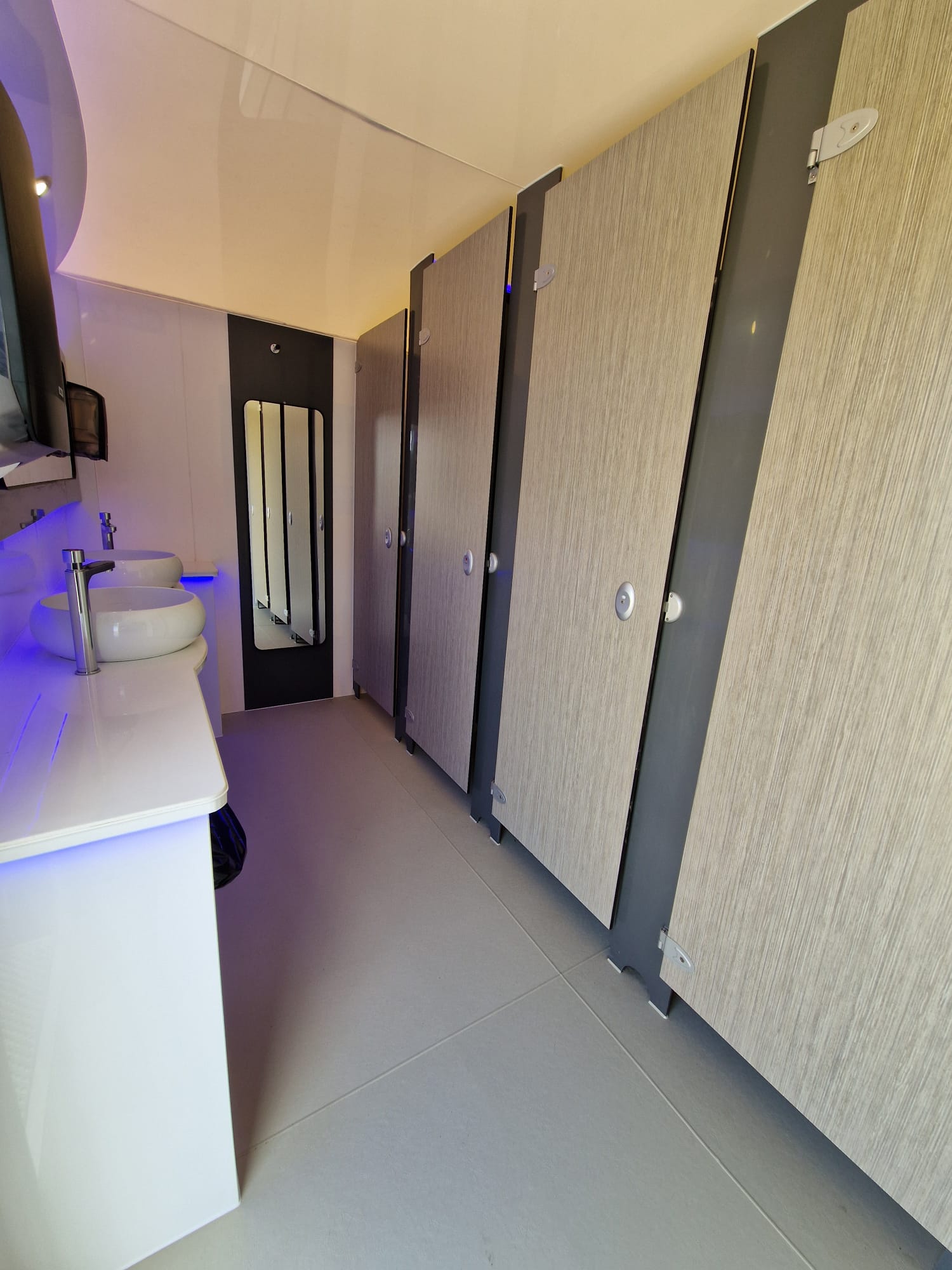
For front-of-house and guest-facing areas, a luxury toilet trailer is a completely different experience. Flushing toilets, running water, mirrors, proper lighting, and climate control. They hold up well over extended hire periods because they’re built for repeated use and are easier to deep-clean between service visits.
For long-term sites, luxury trailers in guest areas pay for themselves in reduced complaints and a better overall event reputation.
Accessible Units
Non-negotiable. Every event site must include at least one fully accessible unit, and on a long-term site that unit needs to be consistently maintained, not just checked at the start of hire. Accessibility should be reviewed as part of every service visit.
Showers and Welfare Facilities
For sites with overnight stays, camping elements, or crew working consecutive days, mobile shower units alongside toilet provision become a welfare requirement, not a luxury. Combining toilet and shower hire from a single supplier simplifies logistics considerably.
Servicing: The Part Most Organisers Underplan
If there’s one area where long-term event toilet hire goes wrong, it’s servicing. A unit that arrives clean and well-stocked on day one will deteriorate fast without a proper maintenance schedule.
What a Service Visit Covers
A proper service visit isn’t just emptying the tank. It should include:
- Waste tank pump-out and flush
- Replenishment of soap, paper, and hand sanitiser
- Inspection of seals, pumps, and flushing mechanisms
- Cleaning of interior surfaces, floors, and door handles
- Check of exterior condition and stability
How Often Do You Need Servicing?
Frequency depends on usage, but as a general guide:
| Site type | Recommended service frequency |
|---|---|
| Low-footfall crew/staff only | Weekly |
| Regular public attendance (daytime) | 2-3 times per week |
| High-footfall festival or event | Daily or every other day |
| Overnight/camping site | Daily as a minimum |
Always agree the servicing schedule in writing before hire begins. Some suppliers include a set number of visits in the hire cost; others charge per visit. On a long-term site, that distinction matters significantly to your overall budget.
Tip: Ask your supplier what happens if a unit needs an unscheduled emergency service. Know the response time and whether there’s an additional charge before you sign anything.
Placement and Site Logistics
Where you put the units matters as much as how many you have. On a long-term site, poor placement becomes a persistent problem rather than a minor inconvenience.
A few principles worth following:
- Keep servicing access in mind from day one. Tanker vehicles need a clear route to reach units for pump-out. If your site layout evolves over the hire period, protect that access route.
- Position units away from food and drink areas. A minimum of 6 metres is the standard guidance, both for hygiene and for the obvious aesthetic reasons.
- Spread provision across the site. A single toilet block at one end of a large site means long walks and concentrated queues. Distribute units to reduce footfall distance.
- Consider ground conditions. Units on soft or uneven ground can shift over time. A stable, level base protects both the unit and the user experience.
- Lighting matters after dark. On a long-term site that operates into the evening, toilet areas need adequate lighting. This is a safety and compliance consideration, not just a comfort one.
For film and TV productions specifically, toilet placement often needs to flex as shooting locations change. A supplier experienced in production work will understand this and can advise on mobile or repositionable solutions.
Planning Your Long-Term Toilet Hire
Long-term event sites need a supplier who understands the ongoing nature of the commitment, not just one who can drop off a unit and disappear. When briefing a hire company, come prepared with:
- Site duration (exact start and end dates, or an estimate with flexibility)
- Peak and off-peak attendance numbers (these will vary week to week)
- Staff and crew headcount on-site at any one time
- Site map or access information for servicing vehicles
- Any specific requirements (accessible units, luxury trailers for guest areas, showers)
- Your preferred servicing frequency and whether that’s included or charged separately
The earlier you book, the better. Long-term hire ties up units for extended periods, and quality suppliers, particularly those offering luxury trailers, can fill up months in advance during the busy spring and summer season.
At GigLoo, we specialise in exactly this kind of hire. Whether it’s a multi-week festival, a film or TV production, or a recurring event series, we can put together a servicing plan and unit mix that keeps your site running cleanly from day one to the last day of hire. Get in touch with us to talk through your requirements.